



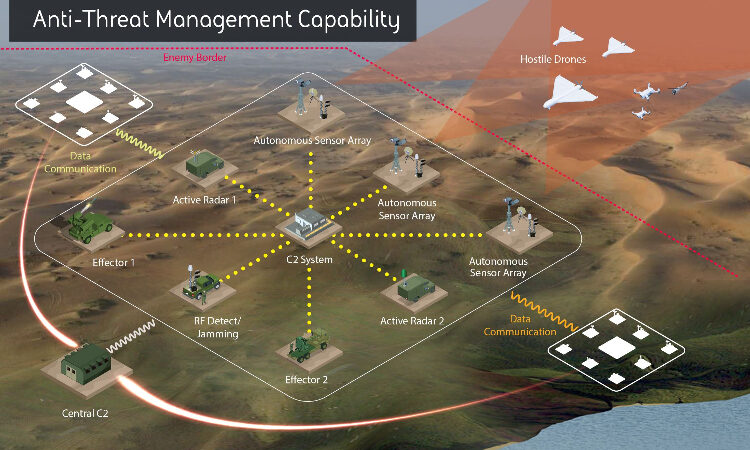
A team of UK based engineers is developing a new way of eliminating hostile drones. The project is being funded and run by BAE Systems, which aims to create a cost-effective new system in months, to address the growing threat posed to key civilian and military infrastructure.
The principle of BAE Systems Anti Threat System (BATS) is to enable customers to reduce the use of missiles by instead deploying smart software, electronic warfare and kinetic measures to tackle increasing drone incursion threats to national borders, military equipment, airports and urban centres.
Work to produce BATS began in October 2025 and is expected to be ready for system testing as soon as April 2026, followed by live-fire trials in early Summer.
BATS includes a scalable, software-driven command and control decision engine to help customers quickly detect, identify and defeat uncrewed threats, including drones. It will feature an open architecture which means customers will be able to integrate current and future counter-threat technologies, including sensors and effectors from across multiple domains, into one system, which can be adapted for different use cases.
“When deployed, BATS will detect uncrewed hostile activity early by fusing intelligence from multilayered sensors into its data core, identifying and classifying the threat level in real time,” BAE Systems said. “Its command and control and decision support capabilities will then apply rapid decision logic to help users decide on the most appropriate response.”
For more information
Image: BAE Systems
The 2026 Unmanned Airspace Global Counter-UAS Systems Directory is now available. The Guide is the world’s only comprehensive, continually updated directory of global C-UAS companies and systems. It itemises over 1,000 C-UAS products and services with performance details, company sales and partnerships arrangements. It is updated every month and broken down into niche sub-sectors (net-capture, missiles, intercept drones, detectors etc) to give C-UAS procurement and industry personnel a unique perspective of global C-UAS technical capabilities and market positions. It is available in word, PDF and excel formats and Unmanned Airspace readers are eligible for a range of discounts. For more information about the Directory please contact the editor Philip Butterworth-Hayes at philip@unmannedairspace.info.