



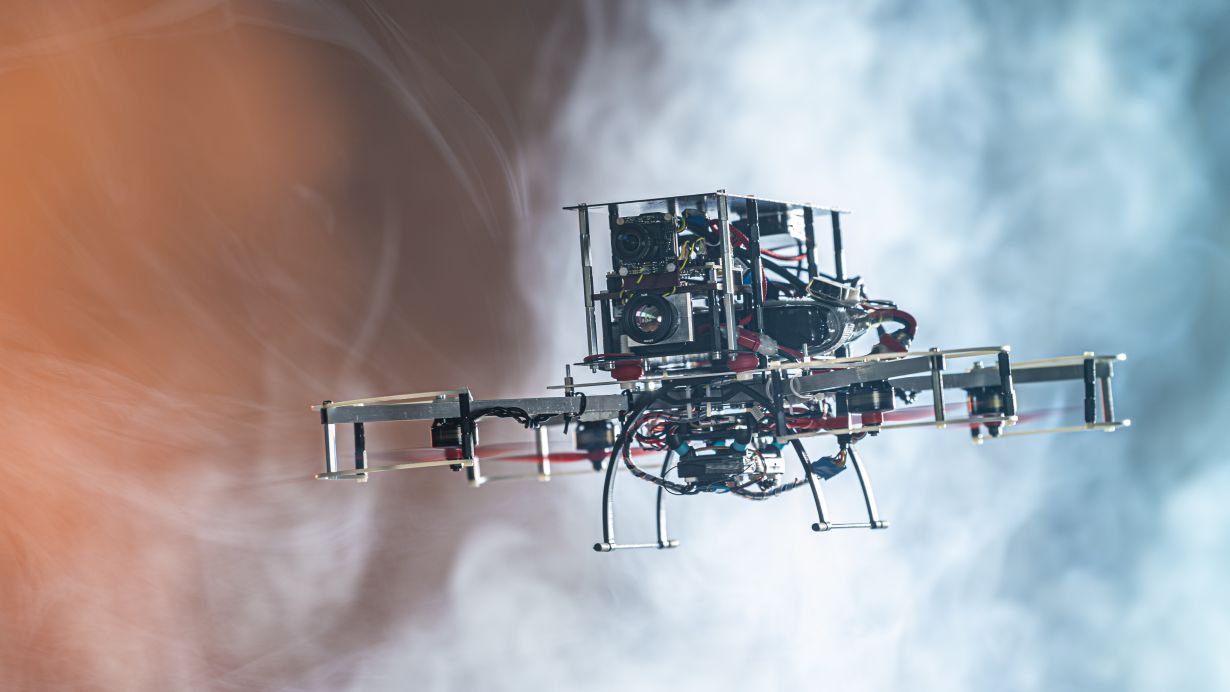
Researchers at the Karlsruhe Institute of Technology (KIT) have developed a new concept for drone defence: thin chains are fired at incoming drones, become entangled in their rotors, and bring them down in a controlled manner. Simulations and initial field tests demonstrate the basic functionality of this approach.
KIT researchers have sought the simplest, most robust, and fastest-deployable approach to drone defence, according to a KIT press release. “The researchers’ approach applies the principle of wrapping to drone defence. Thin metal chains are launched towards the drone using suitable launching devices.”
“We utilize a well-known physical principle, such as that used by shepherds in South America for their bola, and adapt it specifically for drone defence,” said Professor Claus Mattheck, KIT Distinguished Senior Fellow at the Institute for Applied Materials at KIT, who developed the method together with external partners. “Instead of balls on ropes, we use thin chains, which have proven superior in simulations. Upon contact, the chains wrap around the drone’s body and rotors. This causes the rotors to lose their mobility, and the drone crashes.”
An engineering firm conducted calculations to investigate the behavior of chains with diameters of three to four millimeters upon impact with model drones, say the researchers. The simulations took into account factors such as friction, geometry, and motion sequences.
“We have verified the fundamental suitability of the method through these computer simulations. A particular advantage of chains as projectiles is that, when falling, they have less potential for collateral damage than a compact projectile of the same mass,” explains Mattheck. “Further verification was carried out experimentally through firing tests at the Sternenfels Ballistics Center.”
The researchers published the results of the simulations and initial tests in the journals Aerospace & Defence and Konstruktionspraxis. The team plans to expand the field trials in the next step. If these are also successful, industry could adopt the idea for implementation.
Original publication
- Moldenhauer and C. Mattheck: The Chain as a Drone Hunter
https://www.aerospace-and-defence.com/chain-as-a-drone-hunter-a-21cc22a2c6f3be1672fe8d203ff60854/?cmp=beleg-mail&pt=69c639079a111H. Moldenhauer and C. Mattheck: The Chain as a Drone Hunter
https://www.konstruktionspraxis.vogel.de/die-kette-als-drohnenjaeger-a-a04a7695af63c2bdab4c786fa60ef8d8/
(Image: Targeted fire of thin chains of missiles can bring down drones. (Photo: Markus Breig, KIT)
For more information
https://www.kit.edu/kit/pi_2026_042_drohnenabwehr-ketten-bringen-fluggeraete-kontrolliert-zum-absturz.php
The latest edition of the 2026 Unmanned Airspace Global Counter-UAS Systems Directory is now available. The Guide is the world’s only comprehensive, continually updated directory of global C-UAS companies and systems. It itemises over 1,000 C-UAS products and services with performance details, company sales and partnerships arrangements. It is updated every month and broken down into niche sub-sectors (net-capture, missiles, intercept drones, detectors etc) to give C-UAS procurement and industry personnel a unique perspective of global C-UAS technical capabilities and market positions. It is available in word, PDF and excel formats and Unmanned Airspace readers are eligible for a range of discounts. For more information about the Directory please contact the editor Philip Butterworth-Hayes at philip@unmannedairspace.info.