


The Belgian Ministry of Defence said on May 4 that the “technological evolution in anti-drone systems is constantly evolving and requires continuous adaptation”. In response to the increasing threat, the Belgian Army is working on solutions to detect, neutralise and, where necessary, destroy these systems.
“An effective approach starts from a layered structure,” the ministry said. “Initially, passive measures play a role, aimed at limiting detectability and vulnerability. Subsequently, detection tools are deployed, such as specialised radars, optical sensors and radio frequency detection systems. Systems such as the Saab G1X radar, as well as portable and fixed RF detection systems, allow for the detection and potential identification of enemy drones.”
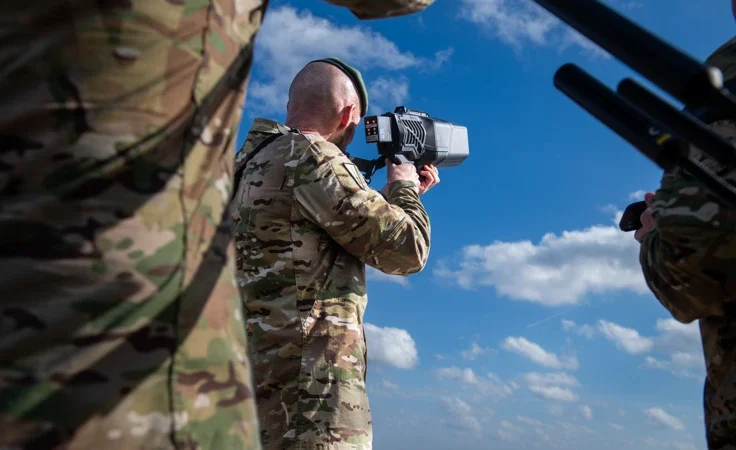
The Army also uses soft-kill counter-uncrewed aerial systems (C-UAS) measures, in which electronic warfare plays a central role. “Systems such as the DroneGun Mk4 disrupt the control signals and GPS navigation of enemy drones through targeted jamming,” the ministry said.
In addition, Belgium recently acquired, among others, the Winchester SX4 shotgun, equipped with modified C-UAS ammunition. This can be deployed to disable drones at close range. Interceptor drones have also been acquired, such as the BLAZE interceptor.
Belgium recently concluded its participation in the final phase of Exercise ORION (Operation for Resilient, Interoperable, High-Intensity Oriented and Innovative) in France, which ended on April 30. Up to 12,500 soldiers from 24 partner countries participated in the large-scale multinational exercise. Belgium’s Artillery Battalion was among the Belgian units participating in a scenario of a high-intensity conflict against an equally matched opponent.
The Artillery Battalion (Bn Aie) was deployed alongside the French 54th Artillery Regiment (54e RA). Their mission was to defend units in the field and protect them against aerial threats including large drones operating at low altitudes.
The operation relied on close cooperation between both countries. A French MARTHA NC1 air surveillance radar provided detection and coordination. The Belgian teams, equipped with MISTRAL short-range surface-to-air missiles among others, were deployed around the command post to create a 360-degree protection zone.
For more information
Image: Ministry of Defence – Belgium
The 2026 Unmanned Airspace Global Counter-UAS Systems Directory is now available. The Guide is the world’s only comprehensive, continually updated directory of global C-UAS companies and systems. It itemises over 1,000 C-UAS products and services with performance details, company sales and partnerships arrangements. It is updated every month and broken down into niche sub-sectors (net-capture, missiles, intercept drones, detectors etc) to give C-UAS procurement and industry personnel a unique perspective of global C-UAS technical capabilities and market positions. It is available in word, PDF and excel formats and Unmanned Airspace readers are eligible for a range of discounts. For more information about the Directory please contact the editor Philip Butterworth-Hayes at philip@unmannedairspace.info.