


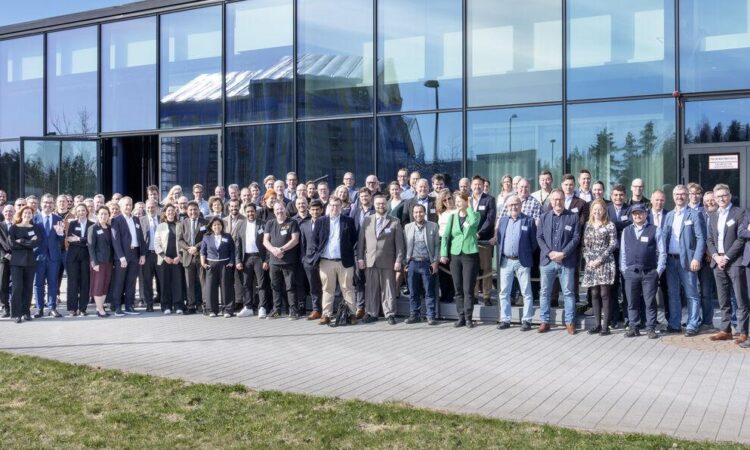
Eurocontrol has published a summary of the U-space stakeholders meeting held in Helsinki, Finland, on 15 April 2026, which brought together 124 in-person attendees and 60 livestream participants from across the aviation and urban planning sectors.
The following text is an edited summary of the proceedings.
According to Rikkard Manninen, Land Use Director for the City of Helsinki, the city is integrating airspace planning into land-use planning, infrastructure decisions, and public safety frameworks. As Rikkard noted, “U-space development is not just an aviation issue. It’s an urban development issue and a planning issue.”
Rikkard’s speech identified three ways that U-space can support the development of innovative urban air mobility: connecting key stakeholders to work out the necessary challenges, creating a trustworthy environment for development, acting as a key enabler of societal and industry growth
The message shared by Pasi Nikama, COO of Fintraffic, offered a different outlook from the city-planning perspective. There are still open questions about how the overall operating model will work in practice, he said. Currently, Finland does not have any certified CISPs or USSPs, and there is no U-space airspace. He highlighted that society appears to accept robots moving on the ground and delivering basic services to citizens but are more cautious about drones doing the same. However, Pasi expressed a positive outlook on the future of unmanned traffic.
The panel “How can U-space support creation of low altitude economy in cities” was moderated by Jukka Savo of DG Move (European Commission), highlighted two patterns emerging at city level to implement U-space: establish U-space airspace as the digital infrastructure, which will create demand for drone operators to use U-space for conducting drone operations; and exploit existing demand for drone operations (e.g. at maritime ports and medical delivery) to drive creation of U-space infrastructure, which will then enhance demand for scaling drone operations
Helsinki and Vantaa in Finland are following the former approach with the city authorities playing a central role by bringing all actors together. On the other hand, Antwerp, Rotterdam, Hamburg and Liege are following the latter approach, where the industry representatives are playing a central role. Either approach is viable to implement U-space.
The panelists highlighted that societal acceptance and public communication play a crucial role in the U-Space implementation. Cities engage with the citizens to highlight importance of drone operations in urban environment. Yet, many actors remain scared of change and may seem opposed to moving away from classical commercial transportation. Besides these hurdles, representatives of cities in the panel concluded that for U-space implementation we must stop talking and start doing.
A second panel titled “U-space as a catalyst for a thriving drone business ecosystem” was moderated by Andrew Hately of Eurocontrol, and emphasised the importance of phased implementation of U-Space to move from pilot to full drone operation, with sustained engagement with civil aviation authority. The panel recommended implementing U-space in a step-by-step manner, gathering operational flight data in every step, learning from the data analysed and moving to the next step. The panel also recommended to spread the cost of drone operations and revenue generated from them across all actors involved. This will help share the financial burden of conducting drone operations as well as obtain buy-in from all actors.
Jukka Savo, Team Leader at the European Commission, presented the recently published Action Plan on Drone and Counter‑Drone Security. Sightings near airports and critical infrastructure can cause major disruption even when they are accidental or wrongly identified. Without better ways to distinguish lawful operators from real threats, authorities may default to blanket airspace restrictions that can harm the legitimate drone economy. European Commission’s action plan on drone and counter-drone security provides an approach to make legal flying easier to identify and trust, through stronger registration and identification and tools like geo‑awareness, geo‑fencing, trusted‑drone labelling, and U‑space as a security enabler that improves situational awareness. The plan spans between different phases: preparation, detection, response, and defence readiness.
The meeting concluded with a poll on the next topics to highlight in future meetings, with the majority voting for discussions on synergy between civil and military sectors to establish U-space, phased implementation of U-Space, and sharing success stories of U-space implementations across the EU. A second poll on whether societal acceptance had grown over the last five years showed only limited progress, scoring 2.3 out of 5.
Next meeting of European Network of U-space Stakeholders will take place on 10 June in Luxembourg at EUROCONTROL’s Aviation Learning Centre.
For more information
European Network of U-space Stakeholders Meeting in Helsinki | EUROCONTROL