



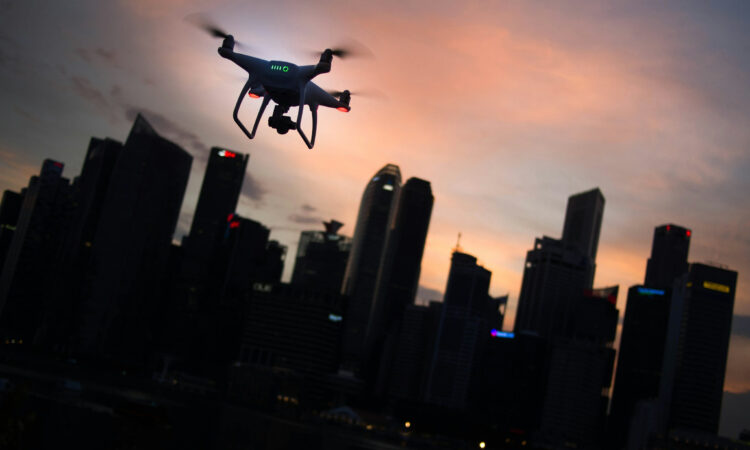
Drone defence frameworks are mismatched to the threat from domestic extremists, says a new policy brief by James Paterson and Lydia Khalil for the Lowy Institute, an independent, nonpartisan international policy think tank located in Sydney, Australia
“Domestic extremist actors are incorporating drone technology into operational capabilities and attack plots, taking inspiration from the battlefield,” the brief says, adding that the number of violent plots utilising drones has increased sharply over the past five years. “Easy-to-access technologies, such as 3D printing, open-source design files, additive hardware and AI-assisted navigation are lowering the barriers to modifying and weaponising drones.”
Understanding the threats and defence vulnerabilities
Paterson and Khalil say that countries should establish domestic counter-uncrewed aerial systems (C-UAS) task forces to tackle domestic actor exploitation of drones. “International knowledge-sharing protocols should be developed among national task forces to guide national coordination mechanisms and help coordinate domestic counter-drone responses.” They also call for internationally coordinated safety-by-design regulations to be implemented to make it easier to identify and respond to malicious drone use, and recommend that specific policy attention and response should be directed towards the threat posed by 3D printing in the additive manufacturing ecosystem.
The policy brief provides an overview of malign actor use of drones, including tactics of the Islamic State, Houthis and Hamas. It also considers how Russia’s invasion of Ukraine and the ensuing conflict has shaped both attack and defence technology, such as the emergence of fibre-optic tethered drones that circumvent jamming capabilities and the development of autonomous drones that track and strike targets through the incorporation of artificial intelligence. All of these methods are widely reported, and in some cases the technology is not too difficult to access or manufacture, making drones a favoured weapon in domestic terrorism’s arsenal.
Paterson and Khalil note that C-UAS efforts in the UK, US and Germany have gone some way to recognise and address the threat but caution that vulnerabilities remain.
“First is the issue of target proliferation,” the policy brief states. “Although the equipment needed to detect and shoot down small drones is cheap compared with high-end air defence systems, each system covers only a small area that requires constant monitoring. There is no one system that could cover multiple potential targets.” The authors add that there is no single C-UAS mechanism that provides comprehensive protection against the full spectrum of vulnerabilities.
Even the planned European Drone Wall Drone would be vulnerable to malign and extremist actor disruption, the authors say, either by jamming the wall’s sensor systems, interfering with command-and-control systems, or attacking the wall’s hardware elements. “Because it is primarily intended as a response to Russian drone incursions, it is not clear if it would function effectively against drones deployed by domestic actors internally, or by adversaries from outside Europe.”
The policy brief notes that while there have been legislative changes made to address domestic drone threats across a number of jurisdictions, challenges remain. For example, while Australian law enforcement can deploy C-UAS tools in exceptional circumstances, most electronic countermeasures remain legally constrained and subject to strict oversight. In addition, requirements for preventive measures in drone design, such as remote identification, can be disabled or circumvented by malign actors.
Paterson and Khalil add that the contemporary drone threat environment is shaped by the convergence of multiple enabling technologies. “Advances in AI reduce operator skill requirements through assisted navigation and object recognition. Improvements in lithium-polymer and emerging solid-state batteries extend potential range and endurance. Encrypted communication, such as software-defined radio, creates complications for signals-based countermeasures. This additive ecosystem undermines detection and mitigation systems that rely on predictable performance profiles of commercially standardised systems.”
Although the threat of drone use by domestic extremist actors is growing, Paterson and Khalil say countries still have an opportunity to act and minimise vulnerabilities. As mentioned, the policy brief includes three recommendations:
C-UAS Coordination and international information sharing
“To begin to address the challenge of domestic extremist and malign actor use of drones, jurisdictions should establish dedicated national counter-drone coordination units, operating as joint task forces, responsible for testing, standardising and evaluating domestic C-UAS tactics within legal and ethical constraints. The task forces would comprehensively bring together law enforcement operational expertise, aviation regulatory authority and intelligence service threat assessment capabilities.”
The policy brief points to the United States’ Joint Interagency Task Force 401, and says similar coordination units could be established to ensure the efficacy of country-specific C-UAS strategies and platforms.
International coordination of safety-by-design regulation
“Governments should also focus on preventive approaches that mandate embedded safety features directly into drone design and production. If geofencing and remote identification become standard across legitimate drone operations, unauthorised activity becomes more visible. By making hobbyist and commercial drones easier to identify, and barring them from sensitive areas, authorities will be able to more rapidly distinguish inadvertent disruptions from nefarious threats. Security personnel can treat unidentified drones operating near sensitive sites as potentially hostile rather than spending time sorting genuine threats from casual rule violations.”
The authors say that the success of regulatory approaches like remote identification rely on international coordination among major markets. “If countries establish common technical standards and mutual recognition of certification, manufacturers face genuine pressure to comply or forfeit market access.
Addressing the threat of additive technology
“Even the most comprehensive safety-by-design frameworks cannot account for the growing threat posed by additive technology. While the additive ecosystem includes several threats, the ease of access to 3D printing for domestic malign actors is particularly concerning. Similar challenges have been highlighted in the space of 3D-printed firearms, where so-called “ghost guns” have provided malicious actors with untraceable weapons that circumvent black-market supply chains. Here, several countries, including Australia and the United Kingdom, have responded by criminalising the manufacture and possession of both the products and their digital blueprints. However, unlike firearms, which are already heavily restricted in most countries, many 3D-printed drone components serve legitimate recreational and commercial purposes. Over-regulation risks alienating hobbyists and stifling innovation. Rather than sweeping restrictions, policymakers should pursue a more targeted response.”
Paterson and Khalil suggest a database of prohibited 3D-printed drone component schematics, which would be regularly updated and accessible to partner states through existing counter-terrorism cooperation frameworks.
“The effectiveness of such a framework relies on widespread industry participation. Printer manufacturers unwilling to implement detection systems or embed identifying protocols would face market access restrictions in participating countries, similar to the internationally coordinated manufacturer enforcement approaches suggested above for commercial off-the-shelf drones.”
In closing, the policy brief cautions that domestic extremists have already demonstrated the will to deploy drones as weapons, and that failures to do so on a large scale should not result in complacency. “It is not a matter of whether domestic extremists will accelerate their use of drones, but whether governments will have done enough to stop them.”
For more information
The ungoverned sky: Drones and the domestic extremist threat
Image: Goh Rhy Yan / Unsplash