


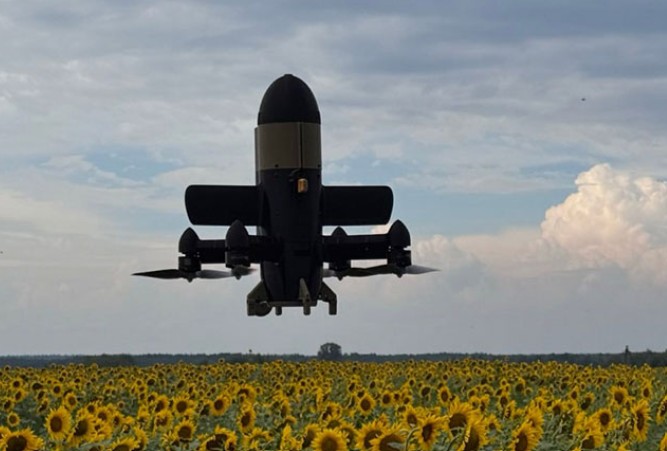
In the counter-UAS world this is the age of the interceptor drone.
According to Ukraine’s Commander-in-Chief, Oleksandr Syrsky, 70 per cent of Russian Shahed-class drones destroyed by Ukrainian forces around Kyiv in February were knocked out by interceptor drones. Production lines, both inside and outside Ukraine, are delivering more than 1,500 interceptor drones to the front lines in Ukraine every week.
With the USA and Gulf states expressing an interest in acquiring anti-Shahed interceptor expertise from Ukraine, which models might be most suitable for export?
“In Ukraine, Shahed drones are typically regarded as a low-threat platform. They are well understood and easily defeated,” according to Joshua Segal in a March 5 Foreign Policy Research Institute article. “Many are intercepted at night using truck-mounted machine guns and various other cost-effective techniques, from aircraft equipped with machine guns and miniguns to small arms and a growing arsenal of homegrown interceptor drones.”
Over the last few years, Ukraine’s domestic UAV industry has developed a range of interceptors aimed at far more formidable targets than Iranian Shaheds, which fly at low levels of slightly less than 200 km/h. This makes them easy targets for Ukraine’s counter-UAS interceptors, once the Shaheds have been detected. The country has developed a range of systems from low-cost, short range FPV interceptors such as the Wild Hornets’ Sting to autonomous systems which operate as part of an integrated air defence system, including radars and AI to identify, track and lock on to targets. Ukrainian interceptor costs range from USD1,500 to USD15,000 – costs averaging around USD2,000 per interceptor once the outliers have been removed. The PAC-3 missile used in the MIM-104 Patriot system reportedly costs more than USD3 million.
The latest generation of Ukrainian interceptors now spans the range from short-range (overhead) interceptions to loitering systems with ranges of up to 150km (see table).
But assessing which models might be most suitable for the use in the Gulf is more complex than first appears.
Interceptors are most effective when they operate as part of a layered air defence system, with detectors and other mitigation measures working together as part of a mobile fire unit. While some of these Ukrainian interceptors can be integrated into air defence systems of other nations, it will take time and expertise to do so.
And then there is the issue of scalability. As mentioned in a previous article, Iran’s January 2025 Treaty on Comprehensive Strategic Partnership with Russia will give it access to Russia’s Shahed-derived Geran-3 and Geran-5 cruise missiles, if Russia has any to spare. These are far more formidable than Iran’s current stock of Shaheds. Flying at speeds of 600 km/h, at altitudes up to 9 km and with a 90kg warhead (in the Geran 5 version), with jam resistant 12-element adaptive antenna arrays, Gerans are effectively low-cost cruise missiles with the potential to bypass many of the counter-UAS systems deployed by states to protect critical infrastructure.
However, for the moment, the urgent need for Ukrainian interceptor drones in the Gulf is for the defence of fixed infrastructure against first and second generation Iranian Shahed attacks.
| Manufacturer | Interceptor |
Characteristics
|
| Deviro | SOKYRA | A prototype undergoing alpha testing, the interceptor reaches speeds of up to 240 km/h, has an operational range of 45 km, and has an endurance of up to 30 minutes. The drone carries a 750-gram warhead. |
| F-Drones | F7 LITAVR | The F7 LITAVR is a low-cost (USD1,500 – USD3,000) FPV interceptor with a maximum speed of 300 km/h and has an operational radius of up to 36 km and a warhead weight of 500g, |
| General Cherry | AirPro | The Air Pro interceptor can reach speeds of over 200 km/h and has a flight time of up to 35 minutes. Daytime target identification is up to 1,500 m. It can carry a payload of up to 0.8 kg and can fly to a maximum altitude of 6.8 km. |
| General Cherry | Bullet | This highly manoeuvrable drone reach speeds of up to 309 km/h, with some models featuring AI for target identification. Endurance is up to 25 minutes, with a target recognition range of up to 600 metres. Warhead mass is 0.4-0.8 kg. It can operate at altitudes of 3km and has a range of up to 17-20 km. |
| ODIN | Win_Hit | The ODIN Win_Hit can fly at 280–300 km/h, with a 7–10 minute flight time, optimized for altitudes of 100m–5km. |
| Piranha Tech | Hunter | The Hunter has a cruising speed of 90 km/h and can accelerate to 340 km/h, reach altitudes of up to 6.4 km, and remain airborne for up to 100 minutes. Its maximum flight range is 150 km, with a tactical radius of 50 km. |
| SEE | SEEDIS | The interceptor has a reported maximum speed of 320 km/h, and a cruising speed of about 190 km/h. It has a tactical range of 18km, extending to over 30km depending on payload and can reach an altitude of 5 km. |
| Skyfall | P1 (Sun) | Built around a modular, 3D-printed airframe, the P1-Sun can operate at altitudes up to 5 km and at speeds up to 450 km/h. |
| Wild Hornets | JEDI Shahed Hunter | A vertical take-off drone capable of carrying up to 500g of payload. Range is 15 km, with an endurance of 12–15 minutes depending on the battery and speed mode. The maximum flight speed with payload exceeds 350 km/h, while the maximum operating altitude is up to 4km |
| Wild Hornets | Sting | Sting can reach flight speeds of 343 km/h and cruise at an altitude of 3 km with an engagement range of up to 25 km. Cost estimates for a Sting is around USD2,100. |
| TAF Industries | Octopus 100 | Octopus features an automated target acquisition module and can carry a 1.2kg payload at over 300 km/h. It has a combat radius of 30 km and a flight duration of 15 minutes and a maximum altitude of 4.5 km. |
| TAF Industries | TAF 1-10 | TAF I-10 interceptor carries a 0.5 kg payload and is operated via manual control, with maximum speeds of over 200 km/h. Its tactical range is 15 km, with a flight endurance of up to 25 minutes and an operational ceiling of 3 km. |
| TechEx | Stalker/Striker | At the September 2025 DroneX show in London TechEx displayed two new low-cost C-UAS intercept drones – the Stalker, a 350 km/h intercept drone with a range of 25km, a flight altitude of 4 km and a target detection range of 500m and the Striker S, a 270km/h intercept missile, with a range of more than 20 km, a flight altitude of 5 km and a target detection range of more than 300m. |
| Tenebris | Bagnet | The Tenebris Bagnet has a range of 15 km, a cruising speed of 140 km/h with a maximum speed of 250 km/h, and a 20-minute flight time. It carries a 1 kg warhead. |
| UKrDefense | Gaarpia | Gaarpia is a modular, catapult-launched interceptor capable of reaching speeds of up to 200 km/h, operating at altitudes of up to 5 km, and remaining airborne for up to 100 minutes. |
| Vinnytsky Bdzholy | VB140 Flamingo | The VB140 Flamingo works at a height of up to 3.5 km and has a range of up to 50 km. It has a maximum payload of 2kg and a cruise speed of 70 ± 20 km/h with a maximum speed not less than 100 km/h. Flight duration is not less than 80 minutes. |
| – | Merops | Merops was developed as part of the US-backed Project Eagle initiative, the interceptor is a short-range, small warhead drone built around Surveyor drones and can reach speeds of over 280 km/h |
Please note – performance characteristics are based on open-source reports and are continually being improved. This is not a comprehensive list but does identify some of the more recent examples of Ukrainian interceptors.
Sources
The main source for this data is the 2026 Unmanned Airspace Global Counter-UAS Systems Directory which itemises over 1,000 C-UAS products and services with performance details, company sales and partnerships arrangements. The March 2026 update edition will be available by the end of this month.
https://bavovna.ai/uav/p1-sun/
https://vartadrone.com/en/main-english/