



The United States defence department, through the Defense Innovation Unit (DIU), is seeking counter-uncrewed aerial systems (C-UAS) products for a Spring 2026 test at Yuma Proving Ground in Arizona.
Proposed solutions are organised into two Lines of Effort (LOE). LOE 1 solutions are intended to establish a persistent, high‑fidelity protective sensing layer over fixed installations within the United States. The solicitation calls for systems that will operate safely near populated areas, within congested airspace and across complex electromagnetic environments dominated by lawful emitters. The intended application includes replacement or augmentation of legacy fixed‑site sensing systems. Solutions may employ single or multi‑modal sensing to enhance the radar solution, however the solution must include a radar sensor as part of the total proposal.
LOE 1 solutions must be able to consistently detect and track all Group 1 UAS types at ranges of 2 km or greater. Autonomous classification of detected tracks, distinguishing small UAS from non‑UAS objects is required, as is effective discrimination of biological clutter, ground clutter and false tracks to maintain a clean air picture. Systems should provide simultaneous detection and tracking of multiple UAS threats. They should also be capable of being rapidly integrated with government-designated C-UAS fire control systems.
Additional, secondary capabilities are also desired and include the capability to detect, track and classify Group 2 and Group 3 UAS with actionable data on threat disposition.
The second LOE solutions are intended to provide small units with resilient, mobile sensing capabilities while stationary and on the move. LOE 2 systems must function in GNSS‑denied or degraded environments and maintain low physical and spectral signatures to support survivability in contested battlespaces. “The solution’s ability to deliver early warning, allowing units to take protective action, is critical and depends upon a low physical and spectral signature to prevent targeting by enemy forces,” the solicitation states. All sensing modalities are welcome, with a preference for passive approaches.
LOE 2 solutions should be able to rapidly adapt to evolving threats. The preference is for solutions with reduced set-up for initial operation including calibration time, reconfiguration time, mean time between failures and efficient operator level repairs. Simultaneous detection and tracking of multiple UAS threats is required and systems must discriminate from biological and ground clutter to maintain a usable air picture.
Teaming is encouraged and the government may seek to team companies with AI/ML solutions with companies that are integrators in the C-UAS technology space or request collaboration between two or more solutions.
Responses are due by February 26, 2026.
For more information
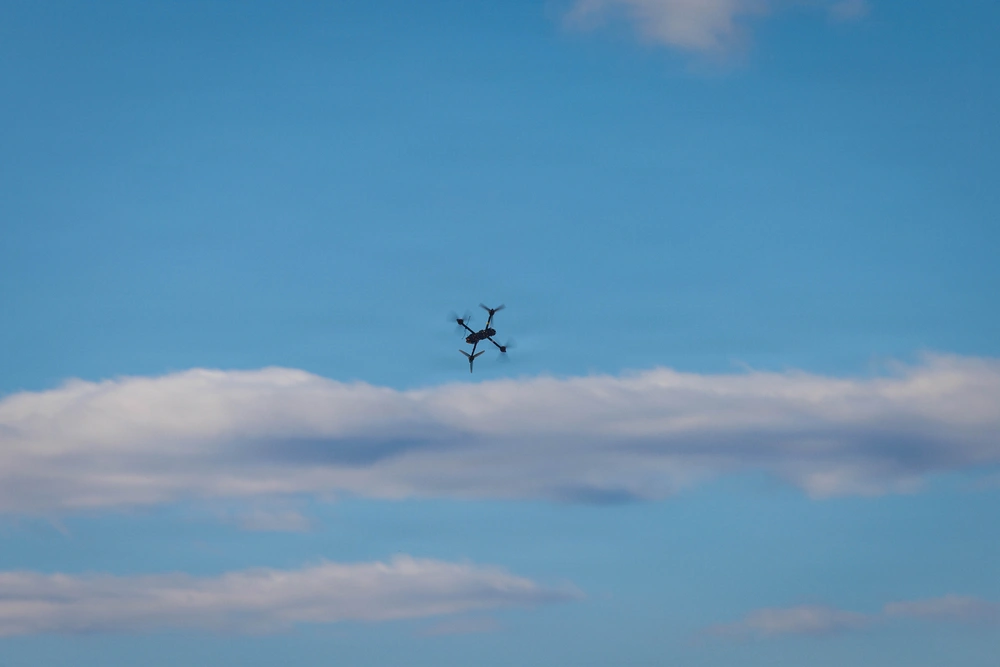
Image: A ‘clay pigeon’ drone prior to being shot down during a C-UAS demo at Marine Corps Base Quantico, Virginia, January 15, 2026. (US Marine Corps photo by Lance Cpl. Donovan E. Melendez)
The 2026 Unmanned Airspace Global Counter-UAS Systems Directory is now available. The Guide is the world’s only comprehensive, continually updated directory of global C-UAS companies and systems. It itemises over 1,000 C-UAS products and services with performance details, company sales and partnerships arrangements. It is updated every month and broken down into niche sub-sectors (net-capture, missiles, intercept drones, detectors etc) to give C-UAS procurement and industry personnel a unique perspective of global C-UAS technical capabilities and market positions. It is available in word, PDF and excel formats and Unmanned Airspace readers are eligible for a range of discounts. For more information about the Directory please contact the editor Philip Butterworth-Hayes at philip@unmannedairspace.info.