



The world would be a very different place today if the explorers of history had stopped at the horizon and gone back home. Similarly, drones can achieve much more when they’re allowed to fly beyond visual line of sight (BVLOS) of their pilots.
This is reflected in the exponential growth of the BVLOS market. Just look at the numbers:
● 30.1%: the projected CAGR of the BVLOS sector in Europe over the next five years, according to Mordor Intelligence.
● 24.6%: the projected CAGR of the BVLOS sector worldwide over the next five years, according to Grand View Research.
● 150%: the rise in BVLOS authorizations across the US, Europe, and the UAE since 2023, according to Drone Industry Insights.
● >25,000: the number of BVLOS authorizations granted by the Federal Aviation Administration (FAA) by 2023, according to the US Department of Transportation.
“2026 is going to be a historic year for aviation,” said Alon Abelson, CEO and founder of High Lander. “We’re seeing it every day – in 2025, we hit a milestone of 10,000 BVLOS flight hours powered and managed by our solutions, and that’s projected to grow to over 30,000 in the first quarter of 2026 alone.”
Clearly, BVLOS is the future of drone operations. But what’s driving this sudden growth? We’ve identified three major factors.
The world needs BVLOS operations
For drone pilots, line of sight is a few hundred meters before their aircraft disappear from view. Much can be achieved in this range, but drones only reach their true potential when they can go further.
When flying BVLOS, drones can provide perimeter security over hundreds of kilometers and provide emergency response services to entire cities. Search and rescue services are more effective, national networks for delivery drones become possible, precision agriculture can be executed on vast scales, advanced air mobility (AAM) services can get off the ground, and much more.

Aviation authorities are making it easier to execute BVLOS operations
Until recently, it’s been challenging to get BVLOS approval from aviation authorities. But that’s changing. Legislators are moving to enable long-range operations at scale in jurisdictions like the UK, Thailand, Kenya, Singapore, Israel, Brazil, Canada, and the UAE, to name a few.
The most dramatic move has come from the USA. The FAA has completely rewritten its drone laws with Parts 108 and 146. These new regulations allow drone operators to receive ongoing approvals to execute BVLOS operations, and codify requirements for unmanned traffic management systems (known in the USA as ADSPs) to keep the airspaces safe.
The USA is already the world’s biggest market for drone operations. This move will have an astronomic effect on their domestic ecosystem, and more importantly, is likely to inspire other airspace authorities to follow suit in order to keep up.
We have the technology to keep BVLOS operations safe
Worldwide restrictions on BVLOS flights were borne of a legitimate concern for safety. Safe operations require reliable connectivity, security failsafes, real-time telemetry monitoring and geo-awareness, and real-time autonomous deconfliction services.
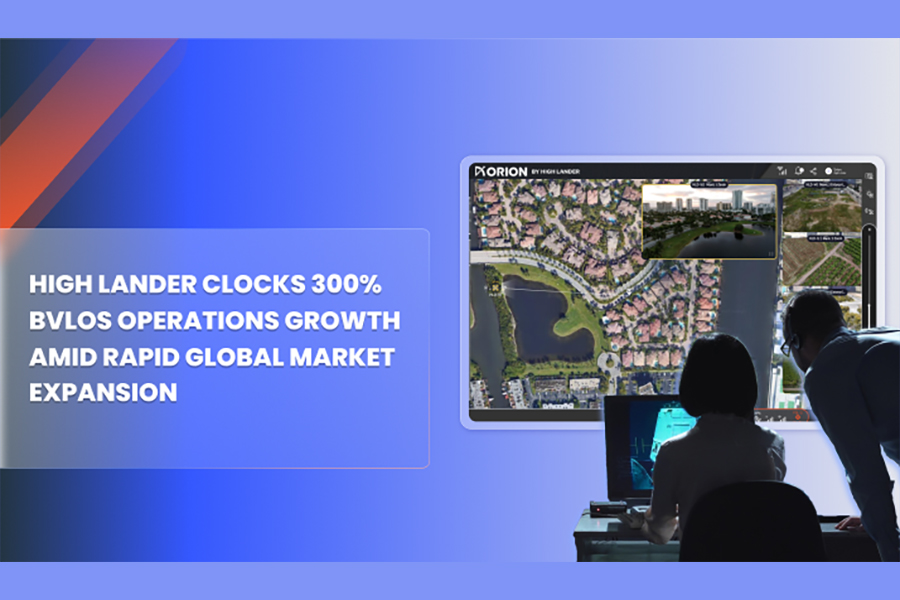
Today, the technology is ready to enable safe BVLOS operations at scale: software-based drone fleet management (DFM) systems and autonomous unmanned traffic management (UTM). High Lander powers and manages operations with Orion DFM, which executes drone missions from a virtual command center at any scale and from any distance, and Vega UTM, which enables full oversight and management of UAS traffic over any size territory.
“Thanks to UTM technology, there’s been a fundamental shift in how airspace authorities treat BVLOS operations – they now understand that there’s an effective way to enable BVLOS ecosystems to flourish safely, and in harmony with general aviation,” noted Abelson.
UTM: driving the BVLOS era
UTM technology represents the next generation of airspace management, providing airspace authorities with the tools they need to let people fly BVLOS operations at any scale.
Take High Lander’s Vega UTM as an example: it provides real-time telemetry monitoring, strategic and tactical deconfliction, prioritization and flight authorization services, a common information service (CIS), real-time geo-awareness and weather data, NOTAM dissemination, integrated counter-UAS services, and more. Alongside Vega HighSite, which provides the full gamut of services for localized airspaces, Vega is a complete infrastructure for safe, compliant BVLOS operations in any territory around the world, at scales from local to national.
“With the right technology, airspace managers can maintain full control and oversight of drones over any size territory and at any distance. As demand grows exponentially, these capabilities become more and more critical,” added Abelson. “High Lander entered 2026 with partnerships, contracts, and revenue tripled year-on-year, dozens of advanced docking stations installed for clients to date, and our projections for Q4 2026 point toward massive growth. This is because our solutions provide a complete airspace management infrastructure, including seamless integration with diverse third-party operators and service providers.”
He concluded: “With the FAA’s new regulations ready to really kick this sector into gear, we couldn’t be more excited about the future. We’re going into 2026 in a position of strength, but this is about more than us. We see our success as proof that it’s no longer a question of ‘if’ or even ‘when’ – the future of aviation is already upon us.”
For more information about how High Lander enables operators to fly BVLOS and gives airspace managers the tools to maintain safety in complex skies, visit www.highlander.io/orion