



The Office of Inspector General (OIG) at the United States defence department (DoD) says “immediate attention” is required to protect DoD covered assets against unauthorised uncrewed aerial systems (UAS).
OIG’s findings follow an evaluation where inspectors visited 10 DoD installations and activities where UAS incursions have occurred. The watchdog also interviewed officials from 31 DoD organisations and four government organisations.
Inspectors obtained documentation including a cost assessment and programme evaluation study on UAS and counter-UAS (C-UAS) efforts within the DoD. However, OIG said that some of the requirements within the DoD documents contradict one another and do not speak to certain aspects of C-UAS authorities and capabilities, which may impact the consistency of C-UAS capabilities use across the DoD.
The evaluation found that DoD did not provide clear policy for designating a facility or assets as “covered”. In the United States, an installation, facility or assets may be given a covered status designation under Code 130i when its mission pertains to nuclear deterrence, missile defence, national security space, protection of the Presidential line of succession, air defence of the United States, combat support agencies, special combat operations activities, production, storage, transportation or decommission of high yield explosive munitions, or a major range or test facility base.
OIG reported that it found instances where facilities that were conducting missions that could have been classed as covered were not designated as such. These included contractor-operated facilities as well as DoD bases like Luke Air Force Base, Air Force Plant 42 and a Newport News facility. OIG said these shortcomings occurred because DoD policy does not provide clear guidance regarding how missions can fall under the covered banner.
OIG also found that a May 2020 policy memorandum required DoD officials to purchase and field C-UAS capabilities, and test C-UAS capabilities in an operational setting before submitting a section 130i package for approval. “Therefore, DoD officials must make significant up-front investments in facilities and assets to procure and test C-UAS capabilities before submitting a section 130i package requesting operational approval to use them,” the watchdog said.
Furthermore, OIG found that the US military services have different policies and procedures for how they complete and submit their section 130i packages. According to OIG’s partially redacted report: “The package complexity, to include varying levels of organisational and leadership approvals, differs drastically by service, making it difficult to deploy C-UAS capabilities.”
OIG determined that a lack of clear, standardised policy and a tendency to allow the services to develop different policies and procedures for prioritising the deployment of C-UAS capabilities led to these challenges. It is worth noting that in August 2025, DoD issued a memorandum that disestablished the Joint Counter-small Unmanned Aircraft Systems Office and established the Joint Interagency Task Force 401 to “better align authorities and resources to rapidly deliver Joint C-sUAS capabilities”.
As a result of its evaluation, OIG recommends that the Secretary of Defense directs the Joint Interagency Task Force 401, in coordination with the Under Secretary of Defense for Policy, to review the existing DoD and service policies for C-UAS and issue consolidated DoD policy that defines clear roles, responsibilities, and authorities; requirements for covered designation for facilities and assets; and a standardised and streamlined process for section 130i packages. The Secretary of the Army, responding for the Secretary of Defense, agreed with the recommendation and said DoD-level policy has already been reviewed and a draft updated policy is being coordinated. The response added that the Joint Interagency Task Force 401 will work with the Under Secretary of Defense for Policy to ensure that clear and concise policy is provided to Force and Installation Commanders.
For more information
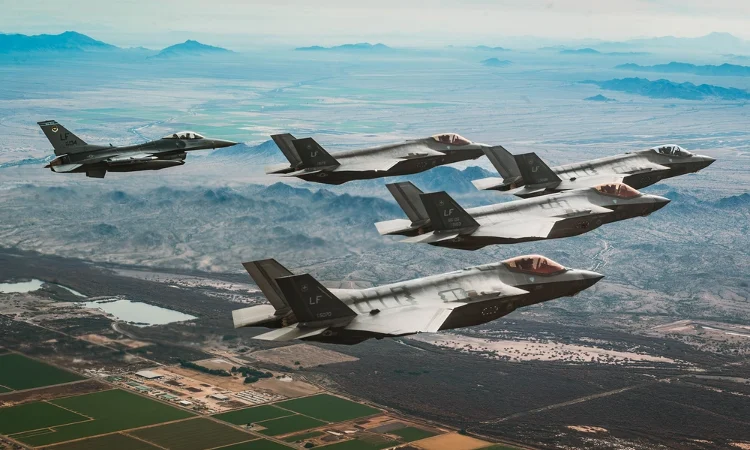
Image: US Air Force F-35A Lightning II’s and an F-16 Fighting Falcon fly in formation, Jan. 19, 2024, over Luke Air Force Base, Arizona. (US Air Force photo by Airman 1st Class Katelynn Jackson)
The 2026 Unmanned Airspace Global Counter-UAS Systems Directory is now available. The Guide is the world’s only comprehensive, continually updated directory of global C-UAS companies and systems. It itemises over 1,000 C-UAS products and services with performance details, company sales and partnerships arrangements. It is updated every month and broken down into niche sub-sectors (net-capture, missiles, intercept drones, detectors etc) to give C-UAS procurement and industry personnel a unique perspective of global C-UAS technical capabilities and market positions. It is available in word, PDF and excel formats and Unmanned Airspace readers are eligible for a range of discounts. For more information about the Directory please contact the editor Philip Butterworth-Hayes at philip@unmannedairspace.info.