


The United States’ defence department’s Joint Inter-Agency Task Force 401 (JIATF-401) yesterday (January 26) announced it has released updated guidance for counter-uncrewed aerial systems (C-UAS) operations.
The department said that “the operational landscape has fundamentally and irrevocably changed” and that “the proliferation of inexpensive, capable and weaponisable UAS by both peer competitors and non-state actors presents a direct and growing threat to our installations, our personnel and our mission, both at home and abroad”.
The guidance is designed to streamline and consolidate existing policies for detecting and mitigating UAS under the authority of 10 U.S. Code § 130i. The updated framework provides commanders with expanded authority and flexibility to control the airspace above their installations.
Key updates to the counter-UAS policy include:
Expanded Defensive Perimeters: The previous “fence-line” limitation has been removed, giving commanders a larger defensive area and greater decision space to protect covered facilities and assets.
Streamlined Threat Identification: Unauthorised surveillance of a designated facility now explicitly constitutes a threat.
Enhanced Interagency Cooperation: Bolstered by the FY26 National Defense Authorization Act, the policy authorises sharing of UAS track and sensor data among interagency partners, including the Department of Homeland Security (DHS) and the Department of Justice (DOJ). It also allows for the use of trained and certified contractor personnel as C-sUAS operators.
Clear Authority Delegation: Service Secretaries are now authorised to designate “covered facilities or assets” based on risk assessments, an authority that can be delegated to Service Chiefs to ensure protection is applied where it is needed most.
In accordance with the new policy, the defence department notes that installation commanders are directed to issue installation-specific operating procedures within 60 days. The guidance emphasises a proactive approach by directing leaders to assess vulnerabilities, conduct rigorous training drills and develop a robust defensive posture to deter and defeat any aerial threat.
For more information
United States defence department
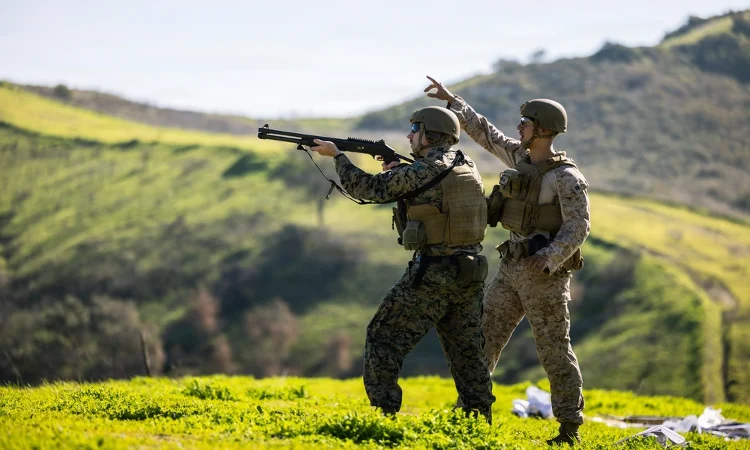
Image: US Marine Corps Master Sgt. Michael O’Brien, left, an operations chief with Headquarters and Service Battalion, 1st Marine Logistics Group, shoots an M1014 shotgun during a counter-small unmanned aerial systems shotgun range during Exercise Steel Knight 25 at Marine Corps Base Camp Pendleton, California, Dec. 2, 2025. (US Marine Corps photo by Lance Cpl. Mhecaela Watts)
The 2026 Unmanned Airspace Global Counter-UAS Systems Directory is now available. The Guide is the world’s only comprehensive, continually updated directory of global C-UAS companies and systems. It itemises over 1,000 C-UAS products and services with performance details, company sales and partnerships arrangements. It is updated every month and broken down into niche sub-sectors (net-capture, missiles, intercept drones, detectors etc) to give C-UAS procurement and industry personnel a unique perspective of global C-UAS technical capabilities and market positions. It is available in word, PDF and excel formats and Unmanned Airspace readers are eligible for a range of discounts. For more information about the Directory please contact the editor Philip Butterworth-Hayes at philip@unmannedairspace.info.