


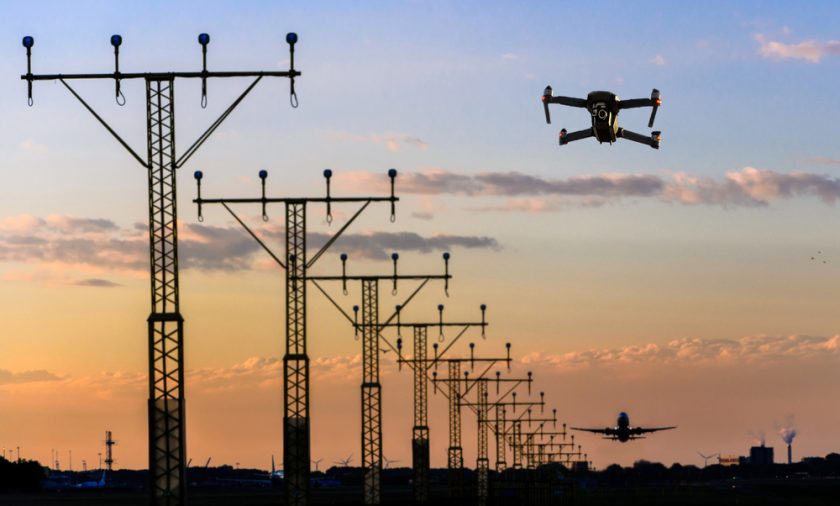
The Association for Unmanned Aviation (UAV DACH) has set out a framework comprising six demands as a contribution to effective and efficient drone detection and defence.
Unified European air picture
First, UAV DACH calls for the creation of a unified European air situation picture in the lower airspace.
“A real-time air situation picture is not only essential for effective and efficient drone detection and defence, but also for the safe, uniform and integrated use of lower airspace, especially given the increasing number of commercial drone applications in the coming years,” the association says.
The Europe-wide, real-time air situation picture for the lower airspace would differentiate between legal and illegal drone operations with binding rules of engagement, clear responsibilities, and technical interoperability between detection infrastructure and government response resources.
Mandatory Europe-wide ADS-L
UAV DACH also wants to see the mandatory Europe-wide introduction of ADS-L for all drones and aircraft in the lower airspace.
“As of today, the identification systems used or required are insufficient for a comprehensive air situation picture with unambiguous identification in real time; consequently, no one can currently identify which aircraft are in the lower airspace, with what purpose, and in what position,” UAV DACH states. “For the development of industrial, fully automated drone operations, the seamless detectability of all air traffic participants is essential, and scalable systems are needed. ADS-L fulfills these requirements and is already recognised as an identification standard in the EU and the European Union Aviation Safety Agency (EASA). From an industry perspective, it is also very cost-effective and scalable.”
Threat scenario definitions
A comprehensive and complete definition of all possible threat scenarios is also needed, the association says, noting that such data would make it possible to identify and define requirements and standards for the procurement of detection and defence technologies in the interest of the entire UAS industry. It would also reveal which technological gaps still exist and could be addressed through industry-related or targeted research and funding projects.
“The goal is to establish a comprehensive, resilient system for drone detection and defence, based on an interplay of legal frameworks, technological based on capabilities, organisational structures, and human competence,” UAV DACH says. “This system must become an integral part of the existing national risk management system and form the basis for a coordinated, safe, and legally compliant response to current and future threats in the lower airspace.”
Drone detection funding
UAV DACH says that the UAS industry needs a holistic research and funding strategy at both the national and European levels. “Currently, there is not a single funding programme that explicitly focuses on UAS, let alone drone detection and defence.
It is calling for the implementation of consistent, industry-oriented and milestone-based funding for drone detection and defence technologies along with a massive expansion of rapid selection and approval procedures to enable a rapid response to new threat situations and technological breakthroughs as well as a reduction of entry barriers for Startups/young companies in funding and procurement processes.
European competence centre for drone defence
“Sectoral solo efforts, disputes over competencies and responsibilities, lack of overview of all possible threat scenarios, lack of overview of existing technologies and technological gaps, preferential treatment of large companies, lack of a legal framework, inconsistent standards and still unclear political responsibilities are neither in the interest of effective and efficient drone detection and defence nor in the interest of industry and the public,” UAV DACH says.
To overcome these shortcomings, the association calls for a European competence centre for drone detection and defence to be established.
Drone technologies are developing rapidly, while individual states are currently pursuing fragmented solutions and focusing only on individual threat scenarios or solutions. A joint centre would pool expertise, harmonise standards, initiate and coordinate continuous research and funding measures, and enable the rapid exchange of air situational awareness, innovations and best practices.
UAV DACH says such a centre would be comparable to Europol in its coordination and exchange function and prevent duplication of efforts.
Private drone operation rules
Finally, the association calls for specification of the rules for private drone operation, noting that it is appropriate to specify the rules for the private operation of drones in order to promote increasing commercial drone operation while simultaneously ensuring greater safety in the lower airspace.
“Rule violations occur, among other things, where rules are complex, communicated inconsistently and not adequately enforced. This weakens social acceptance and market development equally. Specifying the rules for the private operation of drones protects established safety standards while simultaneously enabling the orderly expansion of commercial, socially beneficial drone applications.”
UAV DACH touts the possibility of applying for a time- and geographically limited exemption permit for the private use of drones over public property/areas (e.g., for filming a sporting event) up to a maximum height of 50 metres.
For more information
Image: Shutterstock
This story has been created with the assistance of translation software
The Unmanned Airspace Global Counter-UAS Systems Directory is the world’s only comprehensive, continually updated directory of global C-UAS companies and systems. It itemises over 1,000 C-UAS products and services with performance details, company sales and partnerships arrangements. It is updated every month and broken down into niche sub-sectors (net-capture, missiles, intercept drones, detectors etc) to give C-UAS procurement and industry personnel a unique perspective of global C-UAS technical capabilities and market positions. It is available in word, PDF and excel formats and Unmanned Airspace readers are eligible for a range of discounts. For more information about the Directory please contact the editor Philip Butterworth-Hayes at philip@unmannedairspace.info.