



A group of researchers from the Beijing Institute of Technology has simulated the complete jamming of Starlink in Taiwan. The team proposes to use an extensive network of drones and balloons to form an ‘electromagnetic shield’ over the island and interfere with communications via satellites.
The Maritime Executive explains how the Starlink satellite fleet moves in and out of view quickly in low earth orbit, and the user terminal hops just as quickly from one satellite to the next. “The orbits and the number of satellites in range change constantly and unpredictably. This creates a problem for would-be jammers, which would have to switch just as quickly to match the user terminal’s adjustments.”
A simulation exercise, first reported by the South China Morning Post and picked up by various defence media, saw Beijing Institute of Technology researchers equip between 1000 and 2000 drones with electronic jamming devices to disrupt communication.
Researchers used real data from the Starlink satellite network and created a dynamic simulation of a satellite field the size of Taiwan for twelve hours. Both broadband and narrowband electromagnetic jammers were used in the model. Each radio jamming unit was placed several kilometres apart, at an altitude of approximately 20 km.
Militarnyi reports that, under ideal conditions, China would need 935 coordinated jamming nodes to effectively block Starlink.
An operation on this scale would be costly and the simulation assumes no active air defence capabilities from Taiwan. But as The Maritime Executive writes, it could be a more realistic and safer alternative to the kinetic destruction of a satellite which would release a cloud of debris, with unpredictable effects for everything else in that orbit.
For more information
The Maritime Executive article
South China Morning Post article
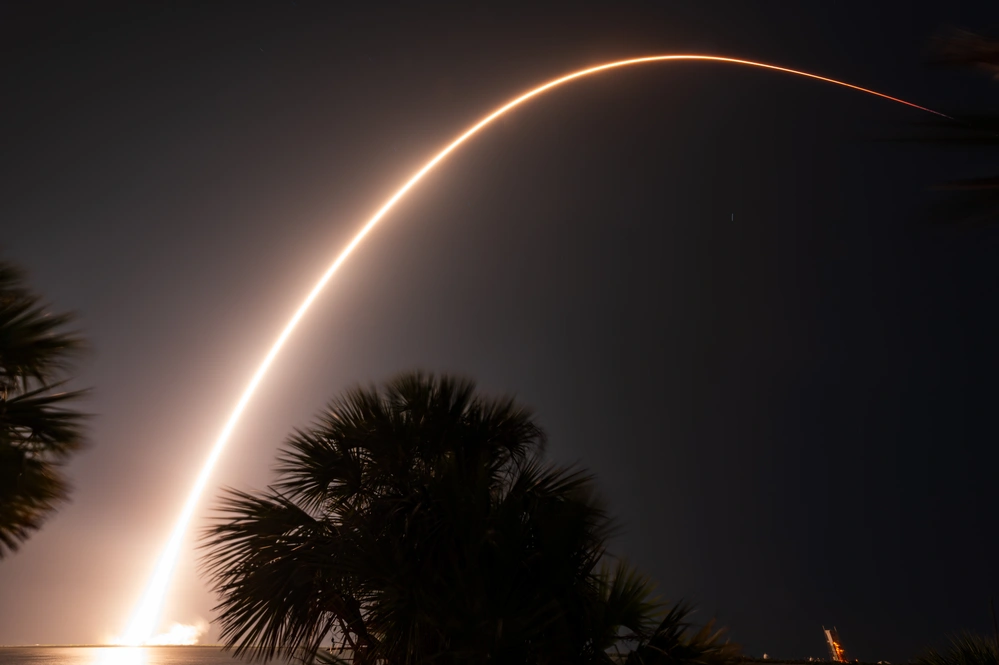
Image: A Falcon 9 rocket carrying the Starlink 6-93 mission lifts off from Space Launch Complex 40 at Cape Canaveral Space Force Station, Florida, on May 6, 2025. This mission added another 28 satellites to the constellation of more than 7,000 satellites currently in low Earth orbit. (U.S. Space Force photo by DeAnna Murano)